
Optimizing Downstream Purification of Viral Vectors for Enhanced Gene Delivery
22/04/2026
Learn how anion exchange chromatography can be used to effectively separate full and empty capsids in the downstream purification of viral vectors, improving gene delivery efficiency.
Understanding the importance of downstream purification in gene delivery
Downstream purification plays a crucial role in the field of gene delivery. It involves the separation and purification of viral vectors, which are widely used in gene therapy. Viral vectors are vehicles that carry therapeutic genes into target cells, allowing for the correction or modification of genetic material. These vectors are derived from various viruses, such as adenoviruses, lentiviruses, and adeno-associated viruses (AAV). However, before they can be safely and effectively used for gene delivery, they must undergo a rigorous purification process to remove impurities and ensure the highest quality and potency of the final product.
The purification process typically consists of several steps, including clarification, concentration, and chromatography. Downstream purification is particularly important because it not only removes impurities but also separates full and empty capsids, which are essential for determining the gene delivery efficiency of viral vectors. Full capsids contain the therapeutic genes and are responsible for delivering them to target cells, while empty capsids do not carry any genetic material and may reduce the overall efficacy of gene delivery. Therefore, the accurate separation of full and empty capsids is crucial for enhancing the effectiveness of gene therapy.
The role of viral vectors in gene therapy
Viral vectors are widely used in gene therapy due to their ability to efficiently deliver therapeutic genes into target cells. They mimic natural viral infections, allowing for the introduction of desired genetic material into the cells’ DNA. This process can be used to treat a variety of genetic diseases, including inherited disorders and certain types of cancer.
Viral vectors are typically engineered to be non-pathogenic, meaning they cannot cause disease in humans. They are modified to remove or disable any genes responsible for viral replication or pathogenicity while retaining their ability to enter cells and deliver therapeutic genes. Once inside the target cells, the viral vectors release the therapeutic genes, which can then be transcribed and translated into functional proteins, correcting or modifying the underlying genetic defect.
However, before viral vectors can be used for gene therapy, they must undergo a thorough purification process to remove any contaminants that may interfere with the therapeutic effect or cause adverse reactions in patients. Therefore, downstream purification is a critical step in ensuring the safety and efficacy of viral vector-based gene therapies.
Challenges in downstream purification of viral vectors
The downstream purification of viral vectors poses several challenges due to the complexity of the purification process and the characteristics of the vectors themselves. One of the main challenges is the separation of full and empty capsids, which is essential for optimizing gene delivery efficiency.
Full capsids, which contain the therapeutic genes, must be separated from empty capsids, which do not carry any genetic material. This separation is challenging because full and empty capsids have similar physical and chemical properties, making it difficult to distinguish between them. Traditional purification methods, such as ultracentrifugation and size exclusion chromatography, may not provide sufficient separation efficiency, leading to a mixture of full and empty capsids in the final product. This can negatively impact the efficacy of gene therapy by reducing the overall gene delivery efficiency.
Another challenge in downstream purification is the removal of impurities, such as host cell proteins, DNA, and endotoxins. These impurities can interfere with the therapeutic effect of the viral vectors or cause adverse reactions in patients. Therefore, it is essential to develop efficient purification techniques that can effectively remove impurities while preserving the integrity and functionality of the viral vectors.
Anion exchange chromatography is an effective separation technique
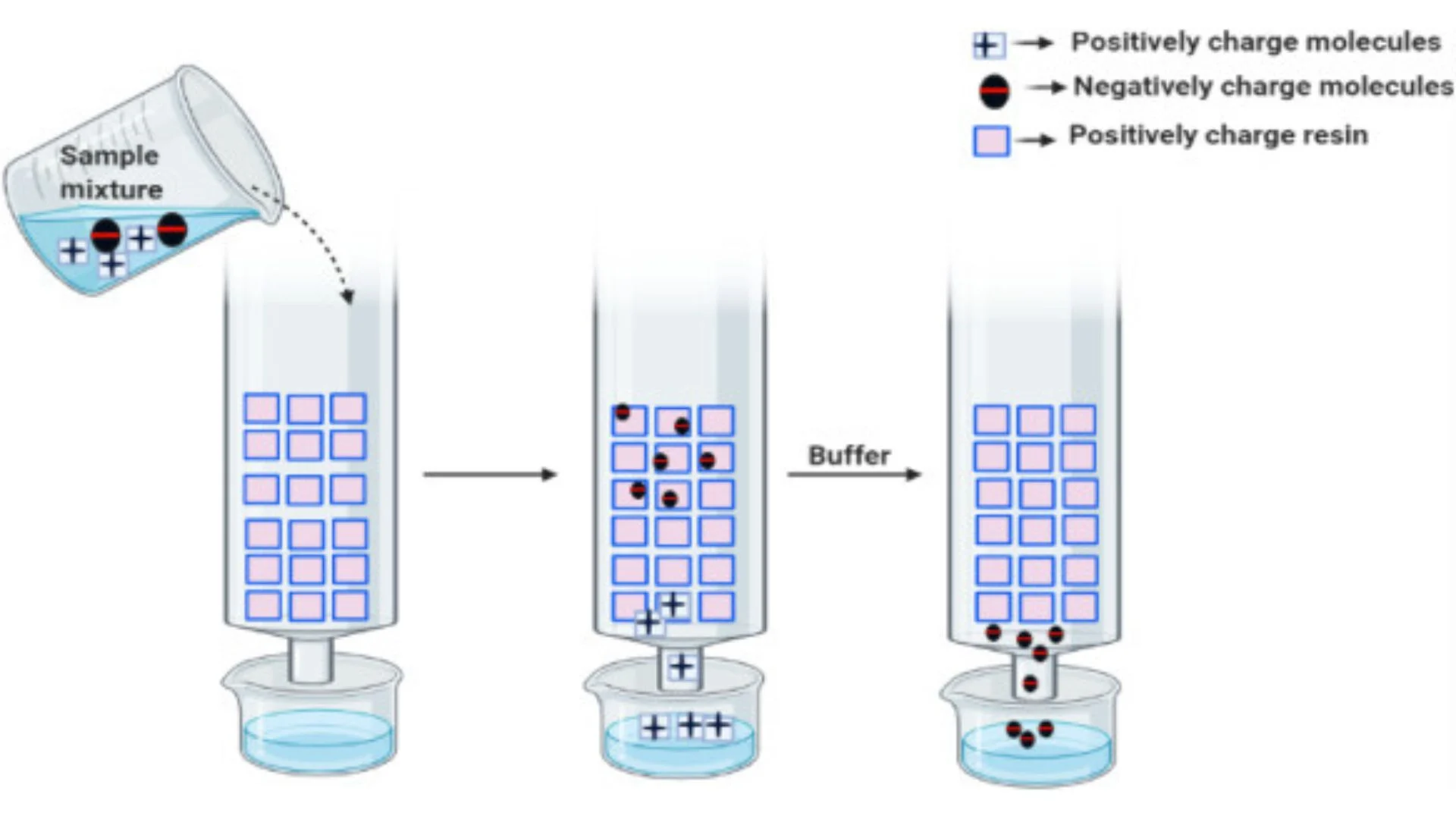
Anion exchange chromatography has emerged as an effective technique for the separation of full and empty capsids in the downstream purification of viral vectors. This technique exploits the differences in the surface charge of the capsids to achieve their selective separation.
 Source: Science Direct – Ion Exchange Chromatography
In anion exchange chromatography, a stationary phase containing positively charged groups is used to attract and bind negatively charged capsids. By adjusting the pH and ionic strength of the mobile phase, the binding and elution of the capsids can be controlled. Full capsids, which have a higher surface charge due to the presence of therapeutic genes, bind more strongly to the stationary phase and elute later, while empty capsids, which have a lower surface charge, bind less strongly and elute earlier.
Anion exchange chromatography offers several advantages for the separation of full and empty capsids. It provides high resolution, allowing for the efficient separation of closely related species. It is also a scalable technique that can be easily integrated into large-scale purification processes. Furthermore, it is a robust and reproducible method, providing consistent separation performance and product quality.
Overall, anion exchange chromatography is a valuable tool for optimizing downstream purification by effectively separating full and empty capsids, thereby enhancing the gene delivery efficiency of viral vectors.
Optimizing downstream purification using anion exchange chromatography
Several factors must be considered to optimize downstream purification using anion exchange chromatography. These include selecting the appropriate stationary phase, optimizing the mobile phase conditions, and integrating anion exchange chromatography into the overall purification process.
- The selection of the stationary phase is crucial for achieving the desired separation efficiency. Different stationary phases with varying surface charges and pore sizes are available, allowing for the customization of the separation conditions. The choice of the stationary phase should be based on the specific characteristics of the viral vectors and the desired separation performance.
- The optimization of the mobile phase conditions, including pH and ionic strength, is also important for achieving the desired separation. By adjusting these parameters, the binding and elution of the capsids can be controlled, leading to improved separation efficiency. It is essential to conduct thorough optimization experiments to determine the optimal mobile phase conditions for the specific viral vectors being purified.
- The integration of anion exchange chromatography into the overall purification process is critical for achieving a streamlined and efficient process. Anion exchange chromatography is typically performed after other purification steps, such as clarification and concentration. Integrating anion exchange chromatography at the appropriate stage maximizes the overall purification efficiency, leading to higher product yield and quality.
In conclusion, anion exchange chromatography is a valuable technique for optimizing downstream purification of viral vectors. By effectively separating full and empty capsids, anion exchange chromatography improves the gene delivery efficiency of viral vectors, enhancing the overall efficacy of gene therapy. With further research and development, anion exchange chromatography has the potential to become a standard purification method in the field of gene therapy, contributing to the advancement of this promising therapeutic approach.
